
As a procurement officer for a correctional institution, you need to control project budgets while meeting safety standards. Therefore, it’s essential to understand the differences between prison beds at different prices and the key factors influencing their price. Today, we’ll analyze the main factors affecting prison bed prices to help our procurement team make the right choices.
Factors Affecting Prison Bed Prices
Material
Prison beds are generally made of stainless steel, rarely wood or plastic. Wood is neither fireproof nor moisture-proof, and plastic has low strength and poor impact resistance. In the harsh environment of prisons, stainless steel beds have significant advantages: they are vandal-resistant, corrosion-resistant, have a long service life, and are easy to clean.
There are three commonly used types of stainless steel: SUS201, SUS304, and SUS316, with 316 being the most expensive, followed by 304, which is the most expensive.
The price difference is due to the different nickel and molybdenum content in the materials:
201 stainless steel: High manganese (Mn), low nickel (Ni). 201 stainless steel has relatively lower costs and is suitable for low-requirement applications. However, it may develop rust spots in humid environments.
304 stainless steel: 18% chromium (Cr), 8% nickel (Ni). 304 stainless steel is moderately priced and resistant to most common corrosion sources (water, atmosphere, common acids).
316 stainless steel: 18% chromium (Cr), 10% nickel (Ni), 2% molybdenum (Mo). 316 stainless steel has exceptional corrosion resistance and is widely used in high-salt, high-acid environments (coastal, medical, chemical, shipbuilding).
Structural Design
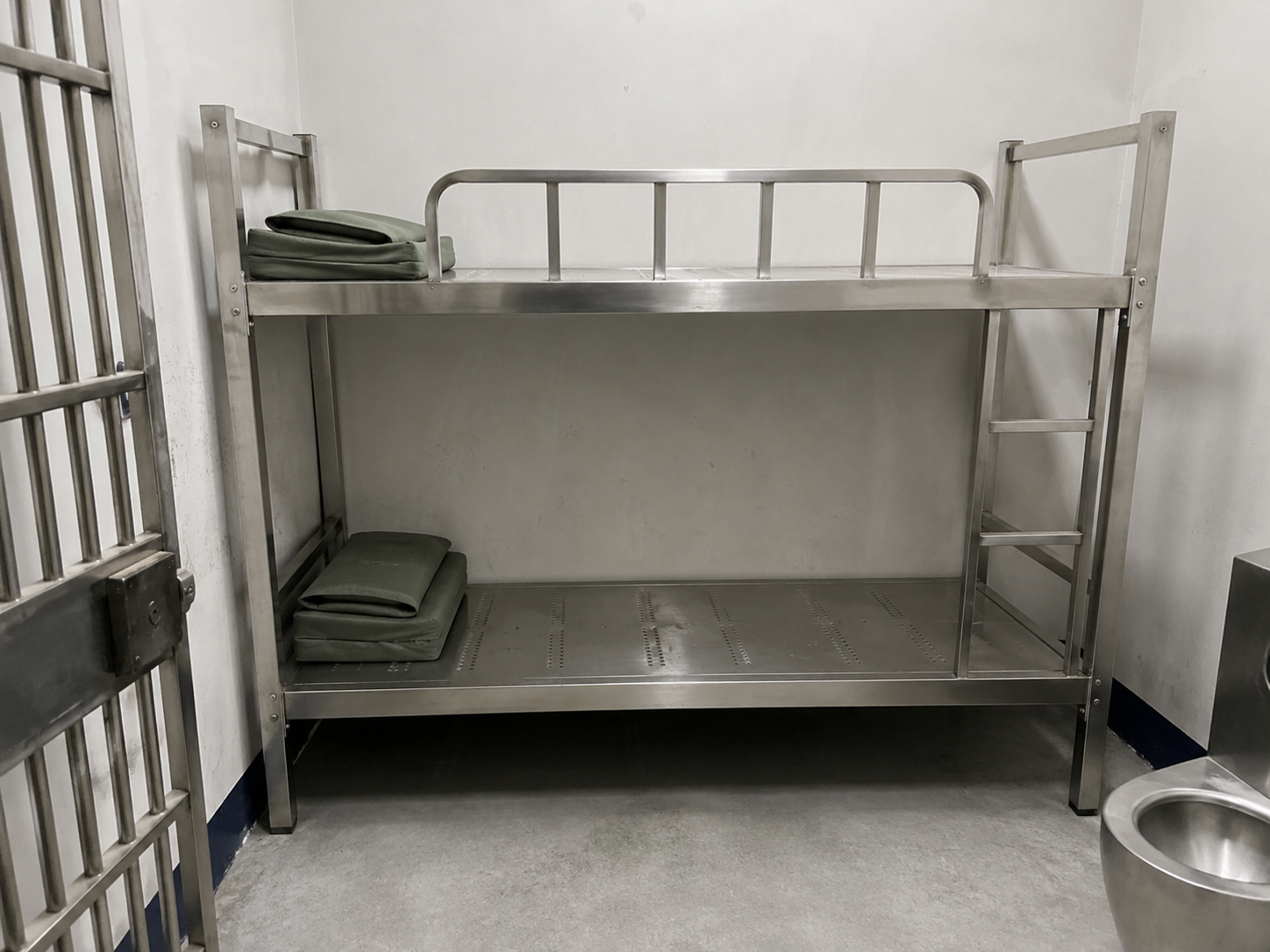
The complexity of the stainless steel prison bed design is also a significant factor affecting its price.
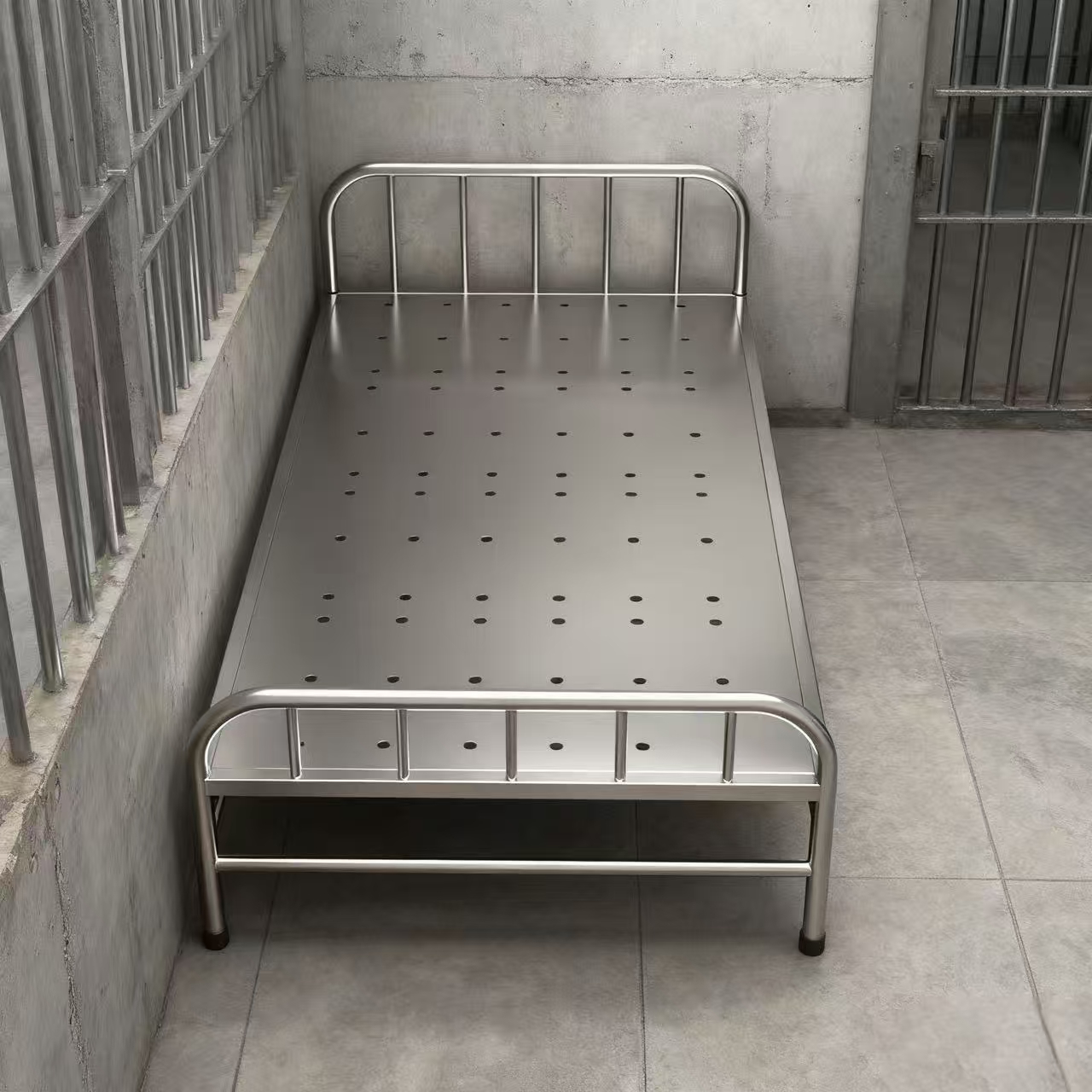
Floor-standing single bed: Relatively simple structure, lower load-bearing requirements, and relatively low cost.
Bunk bed: Double the load-bearing capacity, requiring a reinforced overall frame. The second bunk needs additional guardrails and a ladder structure, resulting in a higher price.
Triple/four-tier bed: Higher tiers require greater stability.
Wall-mounted prison bed: No floor support, wall-mounted installation, requiring thicker steel plates, and also higher price.
Stainless Steel Thickness
The price of stainless steel varies greatly depending on its thickness. Thickness affects the load-bearing capacity, resistance to damage, and lifespan of the bed.
| Thickness | Typical Application |
| 1.0 mm | Low-risk facilities |
| 1.2 mm | Standard correctional facilities |
| 1.5 mm | High-security prisons |
| 2.0 mm+ | Maximum security environments |
The thicker the steel, the higher the price.
Surface Treatment
There are several surface treatments for stainless steel, each with varying costs.
Powder Coating: Powder coating (electrostatic powder coating) uses solvent-free solid powder coatings (such as epoxy polyester or fluororesin). Through electrostatic adsorption and heat curing, it forms a dense coating of 50–100 μm on the metal surface, providing corrosion resistance, wear resistance, and decoration. Many colors are available, and the price is relatively low.
Brushed Stainless Steel: Brushed stainless steel is a surface treatment technology that creates uniform, fine textures on the stainless steel surface through mechanical processing. Its core is to create directional textures on the metal surface through physical friction, combining aesthetics and functionality. This is the most common and also the most expensive.
Electroplating of Stainless Steel: The most common electroplating method for stainless steel is vacuum electroplating. In a vacuum environment, metal is evaporated into vapor, which condenses on the stainless steel surface to form an extremely thin film, making the stainless steel more attractive and durable. Besides vacuum electroplating, there are also traditional water electroplating processes, primarily aimed at giving stainless steel a “protective coat” or “decorative coat,” enhancing its appearance and practicality. Common in high-end projects, this is the most expensive method.
Customization Requirements
Each prison project has different architectural layouts, security levels, and procurement requirements. Customization is common practice in prison furniture procurement, and different customization requirements are a significant factor in the price differences of prison beds. Different sizes, colors, functional requirements, fixing methods, and security levels all lead to completely different prices.
The more customization options, the higher the price.
Order Quantity
The quantity of orders has a significant impact on prices. The more orders you place, the more favorable the prices will be from prison bed suppliers.
| Quantity | Price Trend |
| 1–20 Units | Highest |
| 20–100 Units | Lower |
| 100–500 Units | Much Lower |
| 500+ Units | Best Pricing |
Why isn’t the lowest Price always The Best Deal?
When purchasing prison beds, procurement personnel are advised against buying the lowest-priced option, as a low price does not equate to low total cost. Lifespan and security risks must also be considered.
Low price often means low quality, leading to more frequent quality issues and increased maintenance costs. Low-priced prison beds also have shorter lifespans, requiring more frequent and costly replacements. Furthermore, low price often implies thinner materials, resulting in insufficient vandalism and increased vulnerability to inmate damage, complicating prison security management.
While more expensive products may have higher initial purchase costs, they are simpler to maintain and operate, requiring less frequent replacements. In the long run, the total cost is not necessarily higher.
FAQ
Why are stainless steel prison beds more expensive?
The higher price of stainless steel prison beds is mainly due to the following reasons:
High material cost: Stainless steel is a more expensive material. Compared to wood and plastic, it is stronger and more corrosion-resistant, but it is also more expensive.
More complex manufacturing process: Manufacturing stainless steel beds involves many processes: laser cutting, CNC bending, seamless welding, polishing, etc. More processes mean higher labor costs.
Higher safety requirements: Stainless steel is easily used as a weapon. To improve the security level of prison beds, anti-hanging and anti-disassembly designs are required. Rounded corners, hidden fasteners, and no gaps or protrusions all increase costs.
Does the anti-hanging design increase the price?
Yes. An anti-hanging design is not a simple modification; it requires a complete redesign of the bed structure, eliminating all hanging points and protrusions. All corners must be rounded to prevent ropes from being hung, and the risk of a person bumping into the bed corners is low.
Can prison beds be customized?
Yes, they can. The structure, size, and color of prison beds can all be customized; the material and surface treatment can also be customized; the anti-hanging design, functional integration, and installation method can also be customized.
How long do prison beds last?
Prison beds typically last for more than 10 years, while stainless steel beds typically last for more than 15 years.
Where to Find High-quality Prison Beds?
BACAI Stainless Steel Factory is a professional manufacturer of prison beds, located in Xiangcheng District, Suzhou City, Jiangsu Province, China. We have extensive experience in prison equipment production, and also manufacture various stainless steel prison toilets, urinals, squat toilets, prison tables and chairs, etc., exporting to over 30 countries and regions. With superior quality and consistent delivery, we have earned the trust and long-term cooperation of our customers. BACAI welcomes your inquiries.